
Home » The KIPS Podcast »


What’s Ahead

Modern Fitness Professional

Successful Trainer Traits

Eliminating Mistakes
Earning your personal training certification is a massive milestone, but stepping onto the gym floor as a newly minted coach introduces an entirely new set of professional hurdles. The gap between textbook exercise science and running a highly profitable, sustainable business can be vast. What separates a baseline coach from an elite, high-performance personal trainer who enjoys exceptional client retention and career longevity?
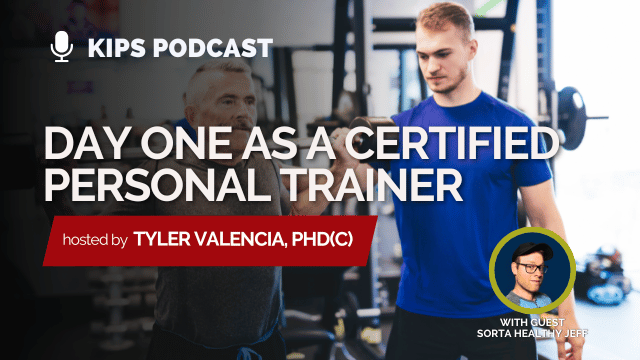
In this episode of the KIPS Podcast, host Tyler Valencia, Ph.D. (c), sits down with Jeff Payne from Sorta Healthy Trainer Education to unpack the foundational realities of building an elite fitness career. From defining true professionalism to exposing the hidden time-wasting traps that stall career advancement, this masterclass provides a definitive blueprint for long-term industry success.
Defining the Modern Fitness Professional
To understand how to climb the ranks in the fitness industry, you must first ask a fundamental question: What does it mean to be a true fitness professional
True professionalism extends far beyond holding an education package or wearing a staff shirt. It anchors directly into your punctuality, your ethical boundaries, your standard of care, and how seamlessly you manage client relationships on the floor. High-performance personal trainers do not treat their hours like a casual, part-time hobby; they treat their schedules and client rosters like an engineered enterprise
A common question that surfaces among incoming coaches is: Do you have to be intensely competitive to be a successful personal trainer
The #1 Quality Found in All Successful Personal Trainers
When analyzing long-term industry data, there is a singular, unshakeable attribute that underpins the careers of top-earning coaches. What is the number-one quality found in every successful personal trainer
The Expert Consensus: It is the relentless capacity for proactive adaptability
.
Every successful coach can share a story of a time they deeply struggled as a new personal trainer
The high-performing trainers are the ones who come out the other side of those challenges, learning something completely new about themselves and the profession’s inner workings. They view floor failures not as a reason to quit, but as a critical learning opportunity to refine their business systems and interpersonal soft skills
Shifting Focus: Eliminating Career-Stalling Mistakes
One of the most tragic errors an entry-level coach can make is misallocating their limited professional energy. There are specific areas and specialized technical skills that trainers tend to focus way too much time on early in their careers that do not actually contribute to their career advancement or monthly paychecks
Spending months memorizing ultra-niche biomechanical anomalies or buying overly complex programming software will not grow your business if you cannot look a prospect in the eye and clearly explain the value of your services.
Instead, there are three core skills a personal trainer absolutely needs to develop within their very first year of being certified to secure financial survival
- The Art of the Consultative Sales Pitch: Learning how to seamlessly uncover a prospect’s true internal motivations and guide them to a package purchase without sounding sleazy.
- Adaptive Verbal Cueing: Translating complex exercise science terminology into simple, actionable descriptions that a beginner client can process instantly without getting overwhelmed.
- Rigid Time and Administrative Management: Structuring an organized weekly schedule to comfortably navigate the split-shift realities of early-morning and late-evening training clients.
The Quick Hits: Certifications, Degrees, and Marketing in 2026
Where Do Advanced Degrees Help Trainers?
While advanced collegiate degrees in exercise physiology or kinesiology provide deep theoretical knowledge, they primarily open doors to clinical rehabilitation and strength-and-conditioning roles for collegiate/professional athletes, as well as higher-tier corporate wellness management
Is an Accredited Certification Required for Success?
-
True or False: Trainers need an NCCA-accredited certification to be highly successful in the fitness industry
-
The Reality: While an accredited certification is absolutely mandatory to clear corporate hiring filters and secure private liability insurance, the actual piece of paper merely functions as your entrance ticket to get you through the front door
The Social Media Mandate in 2026
-
True or False: Social media needs to be a core part of a personal trainer’s marketing strategy in 2026
-
The Reality: True. In 2026, social media functions as your live, interactive resume
What Managers Look For: Traits That Guarantee Hiring Confidence
When a fitness director or gym owner is looking to onboard a new trainer, technical knowledge is only one piece of the evaluation matrix
-
An immediate display of high-level interpersonal communication and eye contact.
-
A proactive willingness to step onto the floor and actively engage with the general gym membership.
-
Coachability, adaptability, and a complete lack of defensive arrogance when receiving professional critique.
Summary
Transitioning into a high-performance personal trainer role requires looking beyond textbook theories and treating your coaching career as an engineered business
The High Performance Career Progression Grid
| Professional Career Metric | The Common Rookie Misconception | The Real-World Floor Reality | High Performance Strategic Action |
| Defining the Identity | A fitness professional is defined strictly by the number of acronyms listed on their badge |
True professionalism is driven by ethical boundaries, punctuality, and client care systems |
Treat your training schedule and client interactions like an engineered corporate enterprise |
| Staff Room Dynamics | You must maintain a cutthroat, fiercely competitive style to steal clients from other trainers |
Success relies on an obsession with client care, empathy, and providing absolute movement value |
Drop the competitive arrogance; collaborate openly with colleagues to master floor dynamics |
| Skill Allocation | Focus massive energy on memorizing niche biomechanical variations to impress members |
An early niche technical focus does not actually contribute to immediate career advancement |
Prioritize the 3 essential skills: consultation pitches, simple cueing, and time management |
| Marketing Channels | Traditional word-of-mouth floor shifting is all you need to build a modern book of business |
Social media marketing is a non-negotiable resume tool for winning leads in 2026 |
Maintain a clean digital footprint showing your unique training style and client results |
| Hiring and Onboarding | Gym owners hire coaches based exclusively on textbook scores and collegiate advanced degrees |
Managers hire based on interpersonal confidence, communication, and immediate coachability |
Display intense eye contact, proactivity, and zero defensive arrogance during interviews |
KIPS Educational Courses – VIEW HERE
Additional Reads


Personal Trainer Interview Checklist

Follow Sorta Healthy Jeff
Jeff Payne is a certified Exercise Physiologist, Licensed Massage Therapist, and owner of Commence Fitness in Southington, CT.